Wallfacer Act
The Dark ForestThe Wallfacer Act is the legal framework that made the Wallfacer Project possible and durable. Born during the Trisolar Crisis, it authorized selected individuals to devise strategies in complete mental secrecy, granted them extraordinary access to Earth’s resources, and protected their decisions from ordinary legal challenge. At the same time, it preserved a narrow power of institutional veto and eventually allowed the United Nations to use the Wallfacer system not only as a defense mechanism but also as leverage over Luo Ji.
Origin in the Trisolar Crisis
The Act emerged from the same emergency that produced the Wallfacer Project. After the appearance of the first sophons, evidence showed that more sophons were continually entering the Solar System and reaching Earth. The enemy could inspect human language, documents, computer storage, meetings, plans, and deployments, leaving humanity with no dependable external secrecy. The crisis therefore exposed a contradiction in conventional government: the more openly humanity coordinated its defense, the more completely its intentions were revealed to the Trisolarans.
The Wallfacer Project answered this problem by relocating strategic secrecy into the individual mind. Trisolarans could understand human language and read every communicated record, but they could not read unexpressed human thoughts. The Act supplied the legal structure for exploiting that difference. A Wallfacer would formulate the true strategy, its necessary steps, and its final objective internally, while presenting the outside world with deliberate falsehood, misdirection, and confusion. The law thus treated private thought as the last territory the enemy could not occupy.
The Act also reflected the peculiar asymmetry of the conflict. The Trisolarans communicated through direct, open thoughts and were consequently described as deficient in tricks, camouflage, and deception. Human civilization’s advantage lay not in superior technology but in its ability to conceal intention. The Act transformed that psychological and strategic advantage into a public institution, even though the institution’s work depended on keeping its essential content outside public knowledge.
Powers and Institutional Limits
Under the Act, Wallfacers received extensive powers to mobilize and exploit a portion of Earth’s military resources. They were not required to explain their commands, however incomprehensible those commands might appear. Their apparent actions could be staged as part of a deceptive maze intended to mislead both the enemy and human observers. In this respect, the law did more than grant authority: it legally protected the appearance of irrationality, allowing a Wallfacer to make confusion itself part of a strategy.
This authority was not entirely unlimited. The Planetary Defense Council was assigned responsibility for monitoring and controlling Wallfacer activity, and it alone possessed the power to veto a Wallfacer command under the Act. The arrangement created an unstable balance between personal sovereignty and bureaucratic oversight. The Wallfacer had to be free enough to conceal the real plan from every outside observer, while the Council retained a final institutional mechanism for stopping an action judged unacceptable.
The Act could also conflict with ordinary legal principles. When Frederick Tyler described a supposed strategy involving dangerous technology, a Wallbreaker’s analysis was posted online in millions of words, much of it derived from sophon surveillance. A subsequent Planetary Defense Council hearing resolved that Wallfacer plans could not contain anything that threatened human life and that, if Tyler’s plan truly existed, carrying it out would constitute a crime against humanity. Yet the same resolution acknowledged that any evidence available to the outside world might itself be part of a Wallfacer’s deception and therefore could not prove that the plan had actually been developed or executed. The Act’s logic made prosecution difficult precisely because uncertainty was one of the Wallfacer’s authorized weapons.
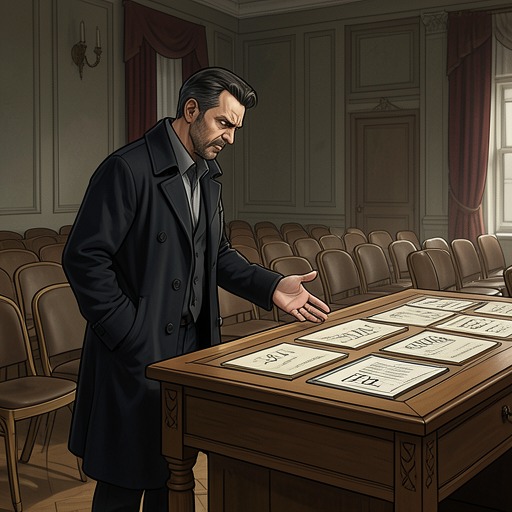
For Luo Ji, the grant of power was almost incomprehensible in its breadth. In the Meditation Room, he realized that he could command immense resources without explaining their use and that he was expected to encourage misunderstanding rather than resolve it. The Act therefore created a form of emergency authority unlike ordinary political office: even absolute monarchs, in his reflection, had ultimately been required to account for their actions.
Continuity Across Centuries
The Act was designed not merely for immediate crisis management but for a war whose decisive moment might lie centuries ahead. It established hibernation as a means by which Wallfacers could bridge the intervening years to the Doomsday Battle. Each Wallfacer could determine when to awaken, under what circumstances, and for how long. The law was to remain in force for the following four centuries, with a status in international law equal to that of the UN Charter and with national laws required to cooperate in carrying out Wallfacer strategies.
This temporal reach changed the meaning of legal authority. The Act did not simply suspend ordinary procedures during a short emergency; it attempted to bind future governments, future institutions, and future societies to decisions made under the initial shock of the Trisolar Crisis. Later records describe the project as having continued for 205 years, including a hiatus of more than a century, while responsibility passed from the former Planetary Defense Council to the Solar Fleet Joint Conference. The Act’s endurance made it a legal bridge between radically different historical eras.
Its rhetoric emphasized the isolation imposed on the Wallfacers. They were said to be undertaking the hardest mission in human history, with their souls closed off from the world and the universe, their only communication partner and spiritual support being themselves. The law’s protections therefore carried a paradox: it elevated private consciousness into a strategic institution while condemning the person who possessed that consciousness to extraordinary solitude.
Abolition and Revival
After the Wallfacer Project had lasted for two centuries, the Solar Fleet Joint Conference considered Proposition 649. The proposition recounted that the project had been unanimously adopted by the permanent members of the United Nations, implemented the following year, and supported by the Act’s privileges. It also judged the project as a product of an exceptional historical moment, born not from rational choice but from desperation and unprecedented fear.
The vote was unanimous. Once Proposition 649 took effect, the Wallfacer Project was terminated and the Wallfacer Act abolished. Bill Hines and Luo Ji were formally notified that their Wallfacer status, associated rights, and legal immunity had been revoked, restoring them to the status of ordinary citizens of their respective countries. The decision ended the Act’s public legal life and, for Luo Ji, symbolically switched off a nightmare that had lasted two centuries.
The abolition did not permanently erase the Act’s power. When the Wallfacer Project was later revived, officials relied on a revised version of the Act to preserve the project’s earlier decisions. Luo Ji discovered that the Hibernation Immigration Bureau would not reawaken Zhuang Yan and Xia Xia, despite his expectation that his former authority would allow it. Hines and Jonathan explained that the revised Act permitted the United Nations and the Wallfacer Project Commission to take all necessary steps to keep a Wallfacer focused on his work. The law had thus returned in a transformed but familiar role: it protected the strategic system by restricting the personal life of the person whom the system claimed to empower.
The coercion became explicit at a secret hearing. Officials demanded that Luo Ji disclose how he had used the spell to destroy a star and suggested that reawakening his wife and child could be made conditional on his answer. They further argued that the revived project preserved the decisions made by the earlier Commission and that Zhuang Yan and his child would awaken only at the Doomsday Battle. The Act consequently made family reunion part of the state’s bargaining power, turning a legal privilege into a means of compulsion.
Political Significance
The Wallfacer Act embodies the crisis-state transformation of law. It protects an individual from ordinary accountability so that the individual can protect civilization from an enemy able to observe every public act. Yet the same legal exception creates a person whose status can be suspended, revoked, or manipulated by the institutions that administer it. Authority moves in both directions: the Wallfacer receives powers no ordinary citizen could possess, while the state acquires grounds to supervise the Wallfacer’s conduct and postpone private claims indefinitely.
Its deepest irony is that the Act institutionalizes distrust as a condition of survival. Humanity must hide its intentions from the Trisolarans, mistrust the evidence surrounding every Wallfacer plan, and accept that even a Wallfacer’s visible behavior may be false. The law therefore preserves civilization by formalizing uncertainty rather than overcoming it. Its history—from emergency creation, through centuries of continuity, to unanimous abolition and coercive revival—shows how an extraordinary legal instrument can outlive the circumstances that justified it and remain powerful precisely because its exceptional logic has become embedded in ordinary political administration.